The Egyptian Book of the Dead is not a book, and knowing that changes how you see Luxor
The Egyptian Book of the Dead is not a book, and knowing that changes how you see Luxor
The Egyptian Book of the Dead is a modern name for a loose collection of around two hundred spells that ancient Egyptians had written on papyrus, coffins and tomb walls so the dead could pass safely through the underworld and come back out into the sunlight. The Egyptians called it the spells for going forth by day. No two copies are the same, there is no author and no fixed order. The scene everyone knows, the heart weighed against the feather of truth, is spell 125. You can see the real thing in Egypt today: papyri in the Cairo museums, and the same spells painted on tomb walls at Deir el Medina, the Valley of the Queens and the Valley of the Kings.
What the Book of the Dead is, and what it is not
Start by throwing out the name. No Egyptian ever called it the Book of the Dead. The German Egyptologist Karl Richard Lepsius coined the term in 1842 when he published a long papyrus in Turin, and the label stuck. The Egyptian title translates as the spells for going forth by day: leaving the tomb each morning and seeing the sun again.
It is also not a book. There was no fixed text, no author, no canonical order. It is a repertoire scribes drew on, and each papyrus carries a different selection in a different sequence. Some rolls run the length of a tennis court. Others are a few feet long with five or six essentials.
The spell numbers you see in museums, spell 125, spell 30B and so on, are modern too. Lepsius numbered his Turin papyrus and later scholars extended the list. It is a filing system unknown to any ancient scribe.
What the spells do is practical: the words to say at each gate, the names of the guardians, the power to breathe, drink, change shape and avoid specific horrors. Less a holy book, more a travel guide for the most dangerous journey imaginable.
From pyramid walls to papyrus: a thousand years of ancestors
Each stage of this tradition tells you who was allowed into the afterlife.
- The Pyramid Texts. The oldest religious texts in the world, carved inside pyramids at Saqqara from the end of the Fifth Dynasty, starting with the pyramid of Unas around 2350 BC. For the king alone, to send him up to join the sun god.
- The Coffin Texts. In the Middle Kingdom, from around 2000 BC, the spells moved inside wooden coffins. Nobles, officials and anyone who could afford a decorated coffin now took them into the tomb.
- The Book of the Dead. From the start of the New Kingdom, around 1550 BC, the spells went onto papyrus, which is cheap, portable and can be made in advance. The audience widened again, and the tradition ran another fifteen hundred years into the Roman period.
Stone to wood to papyrus, king to noble to anyone with means: that is the social history of Egypt in three steps, and you can see all three on one trip. For the cast of characters first, read our guide to the Egyptian gods and how to recognize them.
The famous spells: 125, 30B, 6 and a few strange ones
Spell 125: the judgment and the negative confession
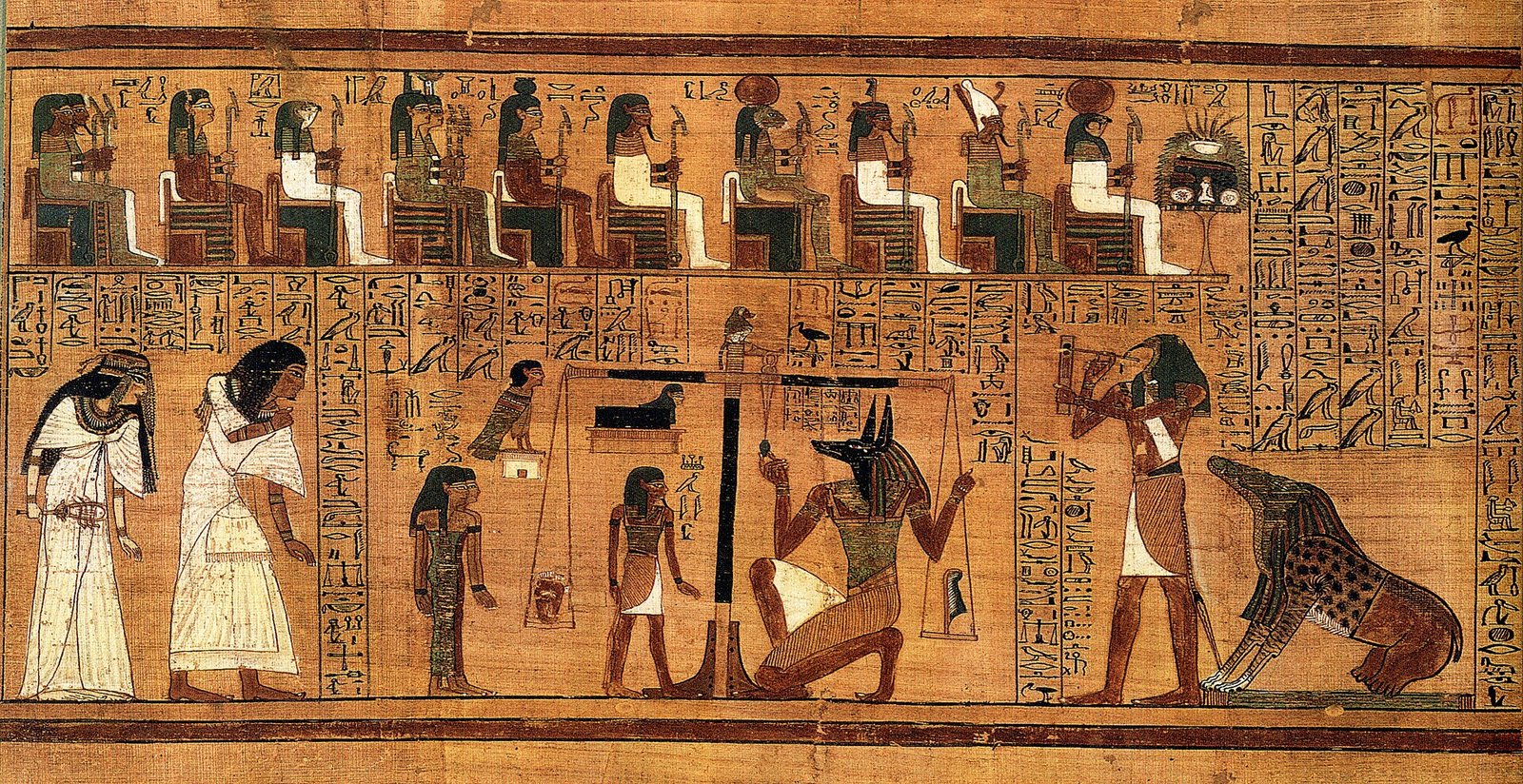
The dead person enters the Hall of Two Truths before Osiris and forty-two assessor gods and declares to each one a sin not committed: I have not killed, I have not stolen, I have not made anyone weep. Scholars call this the negative confession. Its vignette is the weighing of the heart, covered below.
Spell 30B: the heart scarab
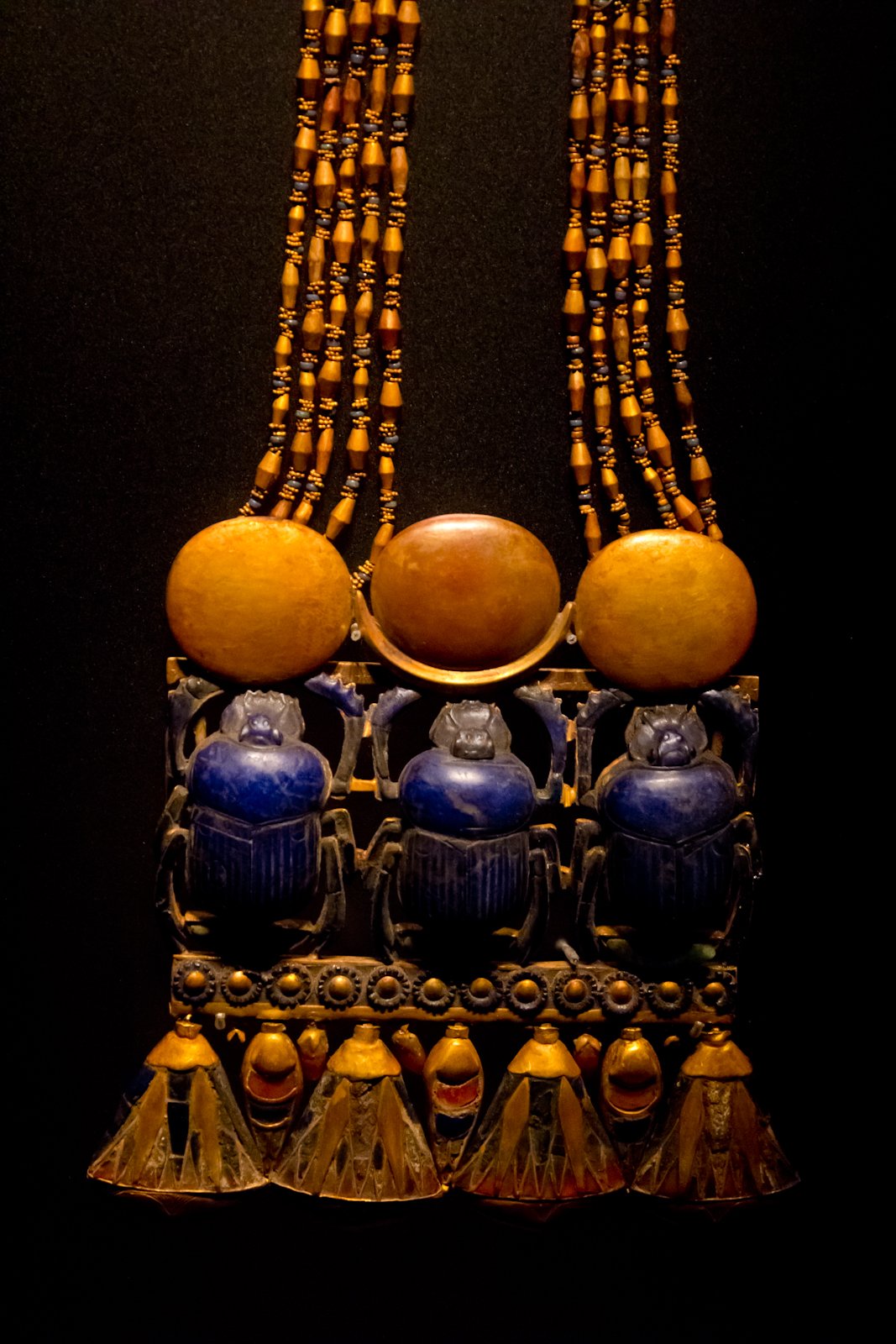
The Egyptians believed the heart held memory and character, so it was the one organ left inside the mummy. It was also the witness at the trial, and it could testify against you. Spell 30B tells the heart not to stand up against its owner, and was carved under a large scarab amulet laid over the heart inside the wrappings. Every museum in Egypt has them. Our page on Egyptian amulets, the ankh, the scarab and the eye of Horus covers the rest of the kit.
Spell 6: the shabti spell
In the afterlife you could be called up for farm work. Spell 6, inscribed on the small mummy-shaped shabti figures, orders the figure to answer in your place whenever your name is called. Wealthy tombs held hundreds.
The strange ones
- Spell 51, for not walking upside down in an underworld that could invert everything.
- Spell 43, for not having your head cut off.
- Spells 76 to 88, the transformations into a falcon of gold, a swallow, a snake, a lotus, a heron.
- Spell 110, the Field of Reeds, the farming paradise where the dead plow and reap forever. The painted version in the tomb of Sennedjem at Deir el Medina is the best-known image of it anywhere.
The weighing of the heart, figure by figure
Name the figures and you can read any version of the scene in seconds.
| Figure | How to recognize it | Role in the scene |
|---|---|---|
| The deceased | White linen, hands raised, often with a spouse | Led in, then presented to Osiris |
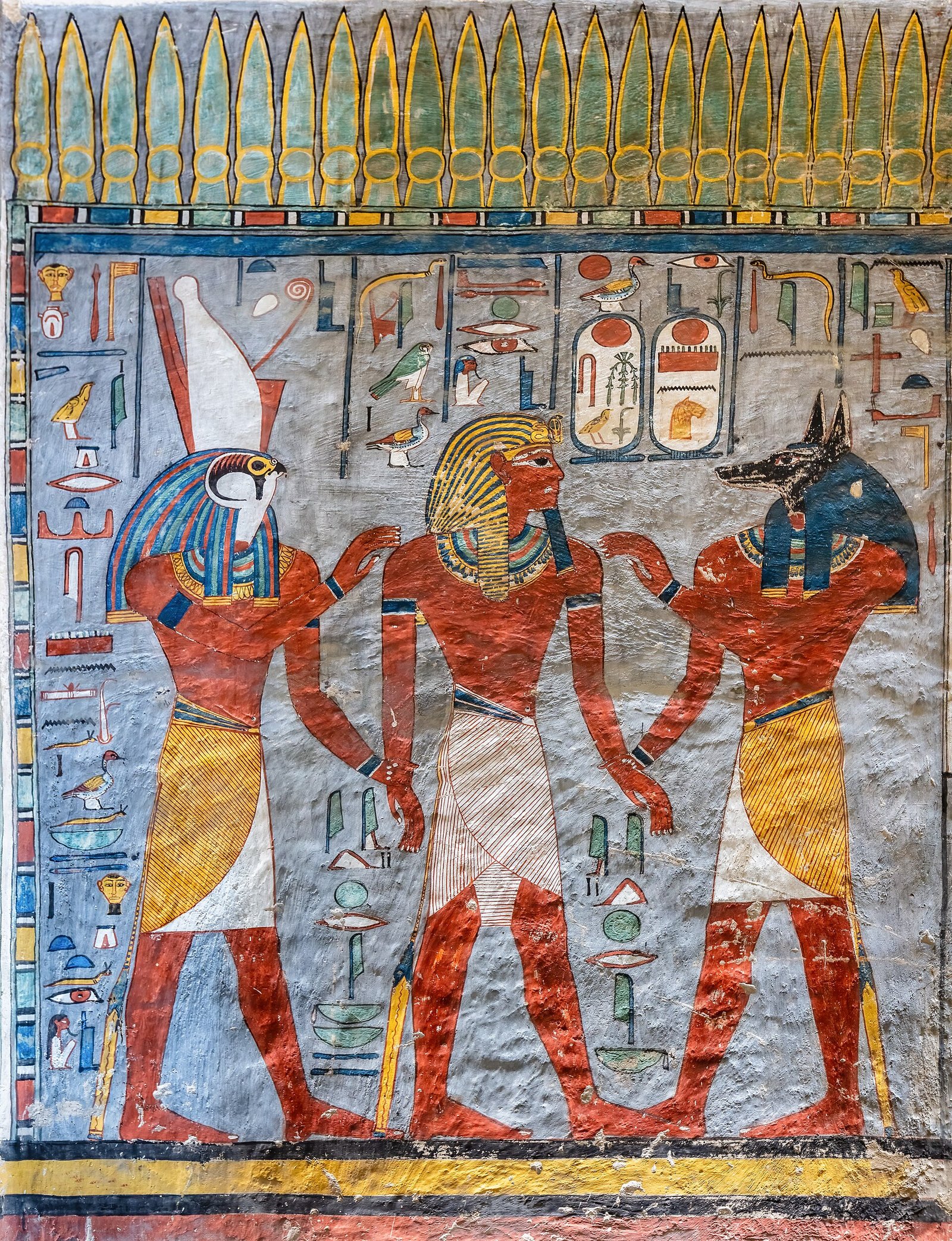
| Anubis | Black jackal head | Leads the dead in and checks the plumb line of the scale |
| Heart and feather | A small jar on one pan, a feather on the other | The heart must not outweigh the feather of Maat, goddess of truth |
| Thoth | Ibis head, palette and reed pen | Records the verdict |
| Ammit | Crocodile head, lion front, hippopotamus rear | Devours a failed heart; the person then ceases to exist |
| Horus | Falcon head | Takes the justified dead by the hand to Osiris |
| Osiris | Green skin, mummy wrappings, crook and flail, tall white crown | Enthroned in a shrine, with Isis and Nephthys behind him |
One detail guides love: the verdict is never in doubt. The heart always balances, because the papyrus itself was part of the magic that guaranteed the result. Nobody commissioned a scroll showing themselves being eaten.
The sins of spell 125 are the closest thing we have to an Egyptian ethical code, and they are strikingly ordinary: do not cheat on weights and measures, do not take milk from a child's mouth. Eternity depended on being a decent neighbor.
The Papyrus of Ani and the Papyrus of Hunefer
Two papyri define the genre for most people. Both come from Thebes, today's Luxor, in the Nineteenth Dynasty, the age of Ramesses II.
The Papyrus of Ani, made for a scribe named Ani and his wife Tutu around 1250 BC, is the longest and most lavishly illustrated copy to survive, roughly seventy-eight feet of papyrus with color vignettes along the top of nearly every sheet: the funeral procession, the judgment, Ani and Tutu praying, playing senet and farming the Field of Reeds. It has been in the British Museum since 1888.
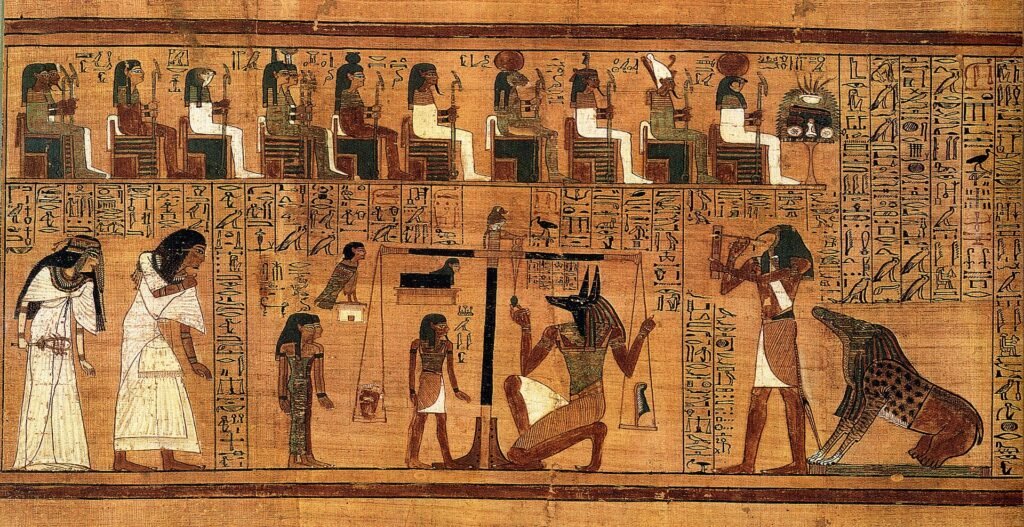
The Papyrus of Hunefer, for a royal scribe, dates from around 1275 BC and holds the single most reproduced image of the tradition: its weighing of the heart, with Anubis leading Hunefer in, Thoth writing, Ammit by the scale and Horus presenting the justified man to Osiris. It, too, is in London.
So the two most famous copies are not in Egypt. Do not let that put you off. The painted tombs in Luxor are the same scenes at full scale, where they were made, with the original pigments on the wall.
How to read a vignette when you are standing in front of one
A papyrus runs in horizontal registers: the spells in columns of hieroglyphs, or later in hieratic, the cursive script, and the vignettes in a band above. Five rules make it readable.
- Find the deceased. The figure that repeats in every scene, in white linen, often with a cone of scented fat on the head and the name captioned above.
- Look which way the figures face. Hieroglyphs are read toward the faces of the birds and people in the signs; the deceased faces the god being approached.
- Read the colors. Osiris is green because he is vegetation returning. Black skin is Nile mud, not death. A blue wig is the hair of the gods.
- Gates and knives. A row of doorways with knife-wielding guardians is a gate spell; the dead person recites each guardian's secret name to pass.
- Food tables. Stacked bread, beer jars and an ox leg are the provisions being guaranteed forever.
To pick out a few signs yourself, our guide to hieroglyphs, what they mean and how to read them gets you to the name of Osiris on any wall.
How a Book of the Dead was ordered and made
It was a product, and the papyri show it. Workshops produced rolls in advance, text and vignettes complete, with blank spaces for the buyer's name. On several surviving copies the name is in a second hand and a different ink, squeezed into a gap that turned out too short.
Quality ran the full range. A bespoke copy like Ani's has careful drawing, full color and superb calligraphy. The cheapest are short strips with a handful of spells and no pictures.
The roll went in close to the body: inside the coffin, between the wrappings, or in later periods inside a hollow wooden statue of Osiris, which is why some copies survived almost untouched. Spells and body were one system, so our guide to mummification in ancient Egypt reads well alongside this one.
Where to see the Book of the Dead in Egypt today
Egypt has papyri behind glass and, better, the spells painted on the walls they were made for.
| Place | What you see | Why it matters |
|---|---|---|
| Egyptian Museum, Tahrir Square, Cairo | Long papyri in wall cases, including the roll from the tomb of Yuya and Tjuyu, plus heart scarabs and shabtis | The densest set of funerary papyri in Egypt; displays rotate |
| Grand Egyptian Museum, Giza | Coffins, shabtis and funerary equipment | Coffin, amulets and spells seen as one system |
| Valley of the Kings | Royal tombs decorated mainly with the Amduat and the Book of Gates, with Book of the Dead spells in several, including the corridors of Ramesses VI | The spells at full scale, carved for a pharaoh |
| Valley of the Queens, tomb of Nefertari | The finest painted tomb in Egypt, essentially a Book of the Dead on walls: the senet game of spell 17, the gate spells, the seven cows of spell 148 | Separate ticket, worth more than anything else on the west bank |
| Deir el Medina, tombs of Sennedjem and Inherkhau | Small, intact, brilliantly colored chambers with the Field of Reeds and Anubis tending the mummy | The men who painted the royal tombs painted their own |
| Luxor Museum | A small, beautifully lit collection of coffins, shabtis and funerary objects from the Theban tombs | An evening stop without crowds |
For tickets and how to combine them, read our guides to Valley of the Kings tickets and tombs and Deir el Medina, the workers' village. For Cairo, see our page on the Egyptian Museum in Tahrir Square.
Papyrus shops and the fakes warning
You will be offered a papyrus of the weighing of the heart within an hour of landing. Most are not papyrus at all.
Real papyrus is made from the pith of the plant, sliced into strips, laid in two crossed layers, pressed and dried. It is flexible, slightly translucent, and shows an irregular crisscross of fibers. On a good sheet the painting is done by hand with visible brushwork.
The fakes are banana leaf or sugar cane pressed into sheets and printed. They are stiff, they crack when flexed, the fibers are regular and stringy, and the image is a flat print, often with suspiciously bright gold.
- Ask to see the sheet flexed and held against the light before any money changes hands.
- Be wary of stops a driver calls a papyrus museum or institute. Some are real workshops; many are showrooms with a commission built in.
- A hand-painted copy of a real scene, Ani's judgment or Sennedjem's fields, beats a generic pharaoh's head.
Our guides know which workshops actually make the sheets they sell.
What a guide adds, and what happens without one
Without a guide, the Book of the Dead is wallpaper. You walk down a Valley of the Kings corridor, see small figures and columns of signs, take a photo and move on. Ten minutes later you cannot say what you saw. A shame, because these walls are among the most legible documents of the ancient world once someone reads them to you.
With an Egyptologist guide the same corridor becomes a sequence: the sun god entering the night, the gate and the guardian's name, the tomb owner reciting the confession, Ammit waiting. In Cairo the guide finds a heart scarab in the case and reads you spell 30B off the back of it.
A guide also knows which tombs to skip, because the best painted tombs open and close for conservation. That is why we never send clients to the west bank with a driver only.
How Explora Egipto builds the Book of the Dead into your Luxor days
We are a local agency in Egypt with our own Egyptologist guides and vehicles, and this theme turns a checklist of tombs into a single story. A typical version:
- Cairo, the first morning. The Egyptian Museum in Tahrir or the Grand Egyptian Museum with a guide who starts at the coffins and shabtis, then the papyri. A domestic flight takes you south that evening.
- Luxor west bank, a full day. The Valley of the Kings first, while it is cool, with tombs chosen on the day for their painted texts. Then Deir el Medina for Sennedjem and Inherkhau, which most group tours skip. For Nefertari, we arrange the ticket in advance.
- Late afternoon. The Luxor Museum, then Luxor Temple lit after dark.
- Next day. Karnak, where the same gods appear in their temple context, then a felucca at sunset.
This fits inside any of our Luxor excursions or a fully custom trip. Tell us how much time you have, and ask us for the quote.
Send me a Cairo and Luxor itinerary with the tombs and papyri
Frequently asked questions
What is the Egyptian Book of the Dead, in one sentence?
It is the modern name for a collection of around two hundred ancient Egyptian spells, written on papyrus, coffins and tomb walls from the New Kingdom onward, that gave the dead the words and powers to pass through the underworld, survive the judgment of Osiris and come back into the daylight. The Egyptians called it the spells for going forth by day.
Is the Book of the Dead a real book I can read?
Yes, in translation. Several scholarly editions exist, most based on the Papyrus of Ani, and they read surprisingly well. No ancient copy contains all the spells, so any printed edition is a compilation rather than one papyrus. Reading spell 125 and spell 30B before your trip is the best single preparation for Luxor.
What happens in the weighing of the heart?
The heart goes on one pan of a scale and the feather of Maat, goddess of truth, on the other. Anubis checks the balance, Thoth records the result, and Ammit, part crocodile, part lion, part hippopotamus, waits beside the scale. If the heart is heavy with wrongdoing she eats it. If it balances, Horus leads the dead to Osiris.
Where is the Papyrus of Ani, and can I see it in Egypt?
The Papyrus of Ani is in the British Museum in London, as is the Papyrus of Hunefer, so neither can be seen in Egypt. What Egypt has are other complete Books of the Dead in the Cairo museums and the same spells painted on the tomb walls of Luxor. Many travelers find the painted tombs the stronger experience.
Which tombs in Luxor show Book of the Dead scenes?
The tomb of Nefertari in the Valley of the Queens is the finest example, a full sequence of spells in perfect color. At Deir el Medina, the tombs of Sennedjem and Inherkhau show the Field of Reeds and spell 17. In the Valley of the Kings several royal tombs, including Ramesses VI, carry Book of the Dead spells. Which tombs are open changes, so ask your guide.
How do I know if a papyrus I am buying is real?
Flex it and hold it against the light. Real papyrus bends without cracking, lets light through and shows an irregular crisscross of plant fibers with hand-painted brushwork on top. Banana-leaf fakes are stiff, opaque, crack when bent, and carry a flat printed image. Buy from a workshop that makes its own sheets.
Walk through the judgment hall with someone who can read it
Tell us your dates and how many days you have for Luxor and Cairo. We come back with an itinerary built around the Book of the Dead, an Egyptologist guide who reads the walls to you, the Nefertari ticket if you want it, and the quote in your inbox.